
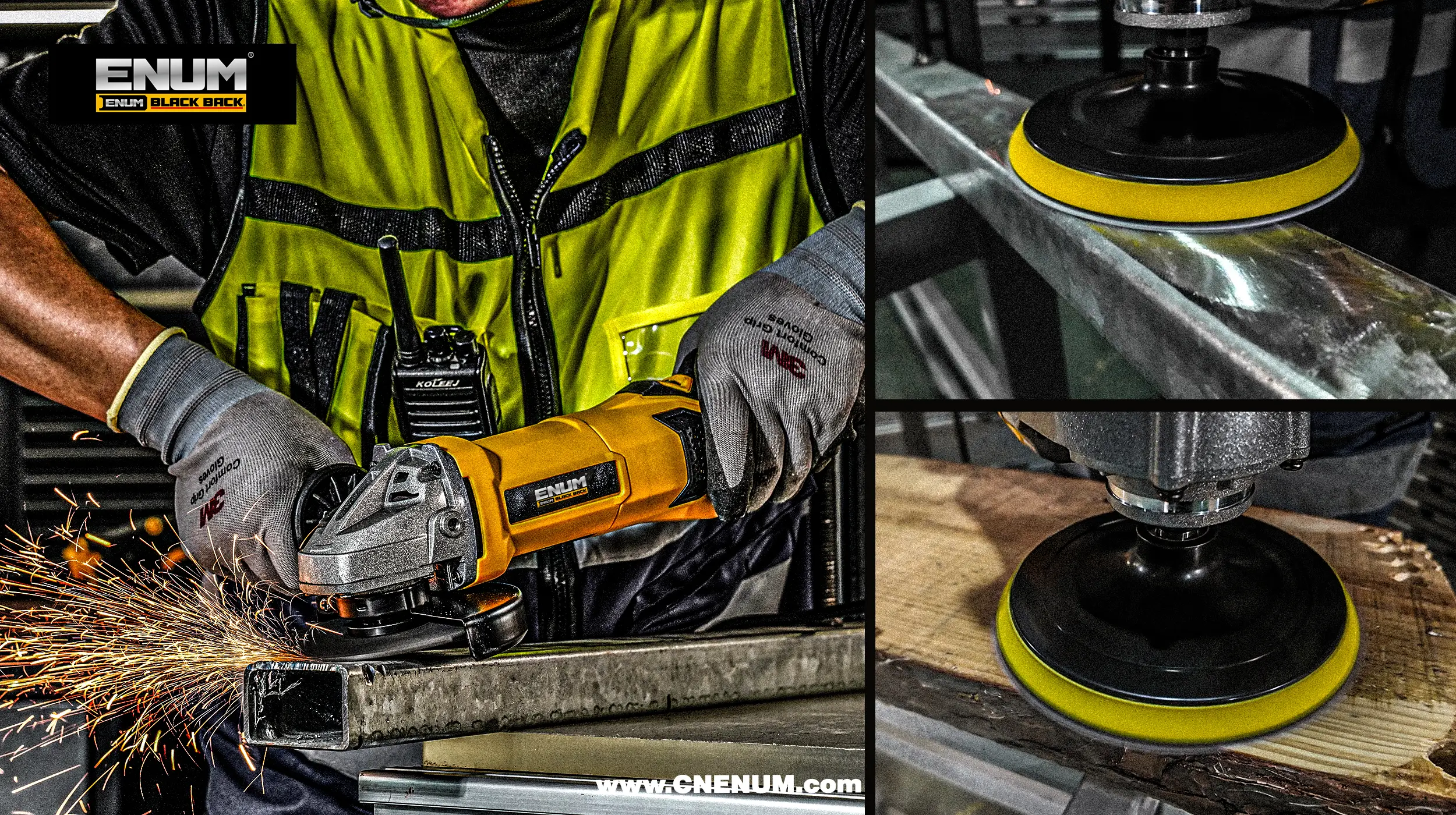
Tools sometimes break in the middle of a project.When a workshop’s orbital sander suddenly stops working, many builders and woodworkers look around the shop for another tool that might finish the job without delaying the work.One tool is almost always nearby.The common 4.5-inch or 5-inch angle grinder often sits on the workbench, so people naturally wonder whether it can be used to sand a surface instead.
The short answer is yes.You can use an angle grinder for sanding if you install the correct attachments and understand the limits of the tool.But there is an important warning.Angle grinders remove material very quickly, and they are designed for cutting and grinding rather than careful finishing.Because of this design difference, they work best for rough shaping or heavy sanding rather than fine surface finishing.Trying to prepare a surface for paint or clear coating with a grinder usually leads to scratches, swirl marks, or heat damage.So expectations must stay realistic.Anyone using a grinder for sanding should understand the tool’s motion, the right accessories, and the safety steps required to prevent damage or injury.
This guide explains those details.It covers how grinders differ from sanders, which sanding discs work best, when grinders are useful, and when a real sander is still the better option.
How Angle Grinders Work vs. Dedicated Sanders
These tools operate in very different ways.Understanding their movement and speed helps explain why grinders can sand material but cannot fully replace a dedicated sanding machine.
Angle grinders spin in a simple circle.Most corded grinders rotate between about 10,000 and 12,000 revolutions per minute when they are running without load.That speed creates strong cutting power.The high rotation allows the grinder to cut steel, masonry, or thick hardwood without slowing down.
Sanders work differently.A random orbital sander spins and moves in small oval motions at the same time.This mixed motion spreads out the scratches made by the abrasive.Because the sanding pattern changes constantly, the tool avoids deep circular scratches and leaves a smoother surface.Orbital sanders also run slower in true rotation speed.Even though they may list 4,000 to 12,000 orbits per minute, the pad itself turns much slower than a grinder.That lower speed reduces heat.It also gives the user better control when smoothing wood, metal, or painted surfaces.
Belt sanders use another motion.They move a continuous loop of sandpaper across two drums in a straight line.This motion cuts fast but remains predictable.Workers can sand with the grain of the wood, which helps keep the surface flat.Grinders create much more heat during sanding.Their speed causes strong friction between the abrasive and the material.Too much heat can burn wood.It can also warp thin metal panels because the metal expands when it gets hot.Another issue is circular scratch marks.Because the grinder spins on a fixed axis, the abrasive cuts round patterns into the surface.Woodworkers often call these “pigtails.”These marks become very visible after applying stain or clear finish.
Random orbital sanders avoid this problem.Their mixed motion blends the sanding pattern so that scratches become much harder to see.
Kinematic and Operational Comparison
Here is a simple comparison of the main sanding tools used in workshops.
Operational Parameter | Angle Grinder | Random Orbital Sander | Belt Sander |
Motion Type | Direct circular rotation | Spin plus random motion | Continuous belt loop |
Typical Speed | 10,000–12,000 RPM | 4,000–12,000 OPM | 900–1,500 SFPM |
Material Removal | Very high | Low to medium | High |
Heat Production | Very high | Low | Medium |
Surface Quality | Rough to moderate | Very smooth | Smooth but linear |
Best Uses | Metal work, heavy shaping | Wood finishing, paint prep | Large flat wood surfaces |
Each tool has a clear role.Choosing the right one depends on how fast you need to remove material and how smooth the final surface must be.
Yes, an Angle Grinder Can Work as a Sander—But Only with the Right Accessories
The correct attachment is essential.Using a normal grinding wheel for sanding will destroy the surface and may also damage the tool.Different sanding discs serve different purposes.Choosing the right abrasive changes how aggressive the grinder behaves.
Flap Discs vs. Sanding Discs
Flap discs are very common.They consist of many small pieces of abrasive cloth attached in overlapping layers to a rigid backing plate.This design gives the disc a longer life.As the outer layer wears down, new sharp abrasive grains appear underneath.Flap discs are strong and flexible.They work well for shaping metal edges, blending welds, and rough sanding of wood.There are two common shapes.Type 27 discs are flat and designed for shallow sanding angles.Type 29 discs are angled.They cut more aggressively and work better when shaping curved surfaces.Traditional sanding discs are flatter.They remove material quickly at first but usually wear out faster than flap discs.
Abrasive Materials and Grit Choices
The type of abrasive grain affects performance.Different materials handle heat, pressure, and hardness in different ways.Aluminum oxide is the most common abrasive.It works well on wood, plastic, and mild steel while remaining affordable.Zirconia alumina is tougher.It lasts longer and performs better when sanding hard metals or thick welds.Ceramic abrasives are high-performance.They stay sharp longer and generate less heat when sanding stainless steel or strong alloys.Silicon carbide is very sharp but fragile.It is mostly used for polishing stone, concrete, or non-ferrous metals.Grit size also matters.Coarse grits like 40 or 60 remove material quickly, while 100-150 grit produces smoother surfaces.
Backing Pads and Hook-and-Loop Systems
Some grinders can use sanding pads with hook-and-loop discs.This setup lets users quickly change between different sandpaper grits.However, speed is a problem.Running these pads at full grinder speed can tear the sandpaper off or melt the hook-and-loop backing.A variable-speed grinder helps solve this issue.Lowering the speed to about 3,000–4,000 RPM makes the tool behave more like a rotary sander.Foam interface pads can also help.They add cushioning and allow the sandpaper to follow curved surfaces without digging into edges.
Clean and Strip Discs for Surface Conditioning
Strip discs are designed for heavy cleaning jobs.They remove rust, paint, and coatings without cutting deeply into the base material.These discs use a web of nylon fibers mixed with abrasive grains.The open structure prevents clogging when sanding sticky materials like old paint.Because the material is flexible, it protects the metal underneath.This makes strip discs useful in automotive repair and restoration work.
Avoid Homemade Attachments
Homemade sanding attachments are dangerous.Angle grinders spin extremely fast and create strong forces during operation.Improvised discs can break apart.Fragments may fly off at high speed and cause serious injuries.Always use products rated for the grinder’s RPM.Commercial attachments are tested to survive the tool’s speed and stress.
When an Angle Grinder Is Actually Better Than a Normal Sander
Grinders sometimes outperform sanders.This usually happens when the task requires heavy shaping or very fast material removal.
Wood Sculpting and Rough Shaping
Grinders work well for carving wood shapes.Artists and furniture makers often use them to shape bowls, seats, and curved designs.Coarse flap discs remove wood quickly.They allow large changes to the shape in a short amount of time.After shaping, finer grits smooth the curves.The final finish usually requires hand sanding or an orbital sander.
Log Cabin Restoration
Restoring log homes requires removing old finishes.The curved surface of logs makes sanding difficult with flat sanders.Angle grinders handle this job well.Flap discs follow the rounded shape and strip away weathered wood quickly.Workers usually start with 40- or 60-grit discs.They then move to finer grits to smooth the surface before staining.
Automotive and Metal Fabrication
Grinders are essential in metal shops.They prepare metal edges before welding and smooth weld seams afterward.In car restoration they remove rust.They also strip thick paint or body filler during early repair stages.However, heat is a risk.Holding the grinder in one place can warp thin metal panels.Because of this risk, professionals switch tools later.They move to dual-action sanders when preparing surfaces for paint.
Deck Restoration
Old wooden decks often have thick coatings.Standard sanders struggle to remove old paint or stain quickly.Angle grinders solve this problem.A coarse sanding disc can strip large areas of wood much faster.But control is important.Tilting the grinder can cut deep grooves into soft wood boards.Keeping the tool flat prevents damage.Wide sweeping motions also help create an even surface.
Conclusion
An angle grinder can work as a sander.With the proper discs and careful control, it becomes a powerful tool for rough sanding and surface removal.Its strength is speed.It removes material much faster than most sanding machines.
But that power has limits.High speed creates heat, scratches, and swirl marks.Because of these problems, grinders are rarely suitable for final finishing.Orbital sanders and belt sanders still produce smoother and more accurate surfaces.For rough work, the grinder is excellent.For fine finishing, dedicated sanders remain the better and safer choice.